
Calciopoli Scandal: The Day Italian Football Died
We all want to believe that football is a clean game where the better team wins. We got the answer in the harshest possible way in 2006.
Imagine a world where the winner of Serie A is known before the players even step onto the pitch, where referees are physically locked in dressing rooms if they do not “listen,” and where the entire football federation operates like a mafia clan.
Did you know that at the time, the best and most glamorous football league in the world was controlled by just one man through several secret mobile phones?
At the center of this mega-scandal, known as Calciopoli, were not just ordinary street-level bettors. This involved entire club management teams, referees, assistant referees, and football officials who worked together to cover up and manipulate dozens of matches every weekend, with one single goal for Juventus to win the title.
This is not a Hollywood movie script. This is the story of how Italy’s most powerful clubs hijacked the game, how the police caught them through intercepted conversations, and why justice ultimately failed, while the biggest “scammers” got away with little more than a slap on the wrist.
Fixed Matches in Calciopoli: How the 2004/05 Serie A Season Was Manipulated
Calciopoli was not just about one match. It was an entire network involving more than 30 fixed and suspicious matches during the 2004/05 season alone.
The investigation focused on a large number of matches, but here are some of the most well-known specific examples that prosecutors used as key evidence in court:
- Juventus – Lazio (2-1), December 5, 2004: Pasquale Rodomonti was the referee for this match. Before the game, referee chief Paolo Bergamo called him and openly told him that “if there is any doubt between the two teams, the team that is behind in the standings (Juventus) should have the advantage.” During the match, several questionable decisions went in Juventus’ favor.
- Fiorentina – Bologna (1-0), December 5, 2004: This is a classic example of pre-match manipulation. During the match, the referee deliberately gave yellow cards to key Bologna players, including their main striker and a key defender, because they had already accumulated several cards. The goal was to suspend them for the next match, which Bologna played against Juventus. The following weekend, Juventus easily beat a weakened Bologna side 1-0.
- Sampdoria – Juventus (0-1), February 2, 2005: Referee Gianluca Rocchi made several controversial decisions. He did not award Sampdoria a clear penalty and also disallowed what appeared to be a legitimate goal for Juventus’ opponents for an offside that did not exist.
Because of this, the court concluded that this was not an isolated incident involving one match, but rather the manipulation of an entire championship. That is why the punishment was so severe: Juventus were stripped of the titles from two full seasons, 2004/05 and 2005/06.
How Did the Calciopoli Match-Fixing System Work?
The main figure behind the operation was Luciano Moggi, the general manager of Juventus. He created a network known as the “Moggi System.” Instead of paying players to concede goals, the system focused on controlling referees.
Moggi worked with senior Italian refereeing officials, club executives from Fiorentina, Lazio, and Milan, and football delegates. They influenced referee appointments and favored officials who would cooperate. Those who refused faced pressure or career setbacks.
According to allegations, referees received expensive gifts and promises of career advancement. In return, they made questionable decisions, including penalties and yellow cards. These decisions could suspend key opponents before matches against Juventus.
How Did Police Uncover the Calciopoli Scandal?
Phone interceptions played a key role in exposing the scandal. Italian police and prosecutors initially investigated doping allegations involving Juventus in 2004. The doping investigation produced no findings, but prosecutors obtained permission to monitor Luciano Moggi’s phone calls.
Investigators recorded hundreds of hours of conversations. Moggi discussed referee appointments, pressured officials, and allegedly threatened referees who made decisions against Juventus.
He also reportedly described locking a referee in a dressing room after the official failed to award Juventus a penalty.
In May 2006, Italian media published transcripts of the intercepted calls. The revelations triggered one of the biggest scandals in football history.
How Much Money Did the Calciopoli Scandal Generate?
Unlike traditional betting scandals, such as Totonero in 1980, Calciopoli did not focus on direct betting profits from fixed matches. The financial advantages came through power, influence, and corruption.
- TV rights and sponsorships: Clubs such as Juventus earned substantial revenue from UEFA competitions, broadcasting rights, and sponsors. League success helped them secure these financial opportunities, while smaller clubs struggled to compete.
- Player values: Winning matches and titles could increase player values in the transfer market. This gave successful clubs another potential financial advantage.
The investigation did not establish an exact amount of money earned through the alleged manipulation.
Calciopoli Scandal: Who Was Punished and Who Took Responsibility?
The Calciopoli scandal brought severe punishments for club officials, referees, and football clubs.
- Luciano Moggi, the former Juventus general manager, received a lifetime ban from football.
- Refereeing officials Pierluigi Pairetto and Paolo Bergamo faced disciplinary action and criminal proceedings. Several referees, including Massimo De Santis, also received suspensions and faced legal consequences.
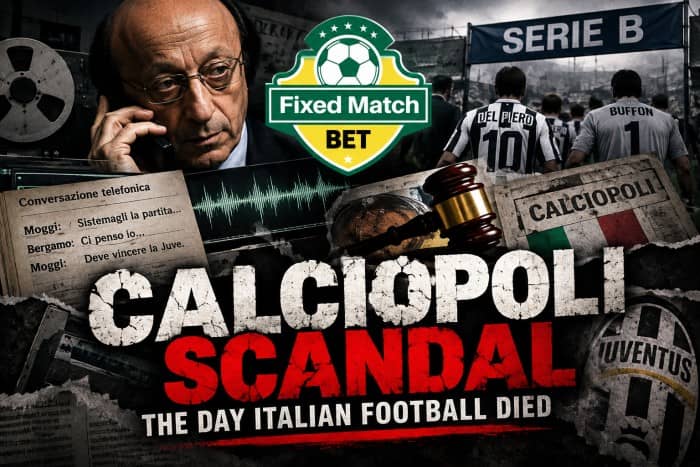
How Did Luciano Moggi Avoid Prison?
Luciano Moggi’s legal case became one of the most controversial parts of the Calciopoli scandal.
In 2011, a court in Naples sentenced Moggi to five years and four months in prison. The case involved allegations of criminal conspiracy and sporting fraud.
However, Italian law includes a statute of limitations known as prescrizione. This rule sets a legal deadline for prosecuting certain crimes.
Moggi’s case continued for years through appeals, hearings, and procedural delays. In 2015, Italy’s Supreme Court ruled that the relevant criminal charges had expired under the statute of limitations.
As a result, Moggi did not serve a prison sentence for the Calciopoli case.
What Happened to the Other Officials?
Several referees and football officials also faced criminal proceedings. Some initially received prison sentences ranging from one to three years.
Italian law allowed certain shorter sentences to be suspended under specific conditions. This meant that some defendants could avoid serving time in prison.
Former Juventus executive Antonio Giraudo also faced legal proceedings connected to the scandal.
For many officials, football bans and suspensions became the most lasting punishments. These penalties prevented them from returning to professional football, even when criminal proceedings ended without imprisonment.
Calciopoli Scandal: What Punishments Did the Clubs Receive?
In July 2006, Italian football authorities announced severe penalties for the clubs involved in the Calciopoli scandal.
- Juventus received the harshest punishment. The club lost its 2005 and 2006 Serie A titles. Italian football authorities also relegated Juventus to Serie B. The team started the 2006/07 season with a nine-point deduction.
- AC Milan, Lazio, and Fiorentina also lost points. Milan started the following season with an eight-point deduction, Lazio with three points, and Fiorentina with fifteen points. The penalties also affected their participation in European competitions.
Why Did Some People Consider Juventus’ Relegation Too Lenient?
- Immediate return to Serie A: Juventus kept important players, including Alessandro Del Piero and Gianluigi Buffon. The club won Serie B in its first season and returned to Italy’s top division.
- Long-term dominance: Juventus later built a new stadium and regained its position among Italy’s strongest clubs. Between 2012 and 2020, the team won nine consecutive Serie A titles.
From a sporting and financial perspective, critics argued that Juventus recovered too easily.
How Did Inter Milan Benefit From the Calciopoli Scandal?
The Calciopoli scandal removed Juventus from Serie A and weakened several competing clubs. Inter Milan gained a major sporting advantage and entered one of the most successful periods in its history.
Inter Milan Received the 2005/06 Serie A Title
Juventus originally finished the 2005/06 season in first place, ahead of AC Milan. Inter Milan finished third.
After the authorities stripped Juventus of the title and penalized Milan, they officially awarded the championship to Inter.
Some Italian football supporters called this title “Scudetto di cartone,” meaning “cardboard Scudetto.”
The club won five consecutive Serie A titles from 2006 to 2010. Inter completed this successful period by winning the Champions League in 2010 under José Mourinho.
How Did Inter Sign Juventus’ Star Players?
Juventus faced serious financial and sporting problems after its relegation to Serie B.
Several important players left the club during the summer of 2006. Inter took advantage of the situation and signed two major Juventus stars.
- Zlatan Ibrahimović: Inter signed the Swedish striker from Juventus for approximately €24 million. Ibrahimović became one of Inter’s most important players and helped the club win several league titles.
- Patrick Vieira: The French midfielder also moved directly from Juventus to Inter. His experience strengthened Inter’s midfield during its successful period.
How Did AC Milan Benefit Despite the Calciopoli Punishment?
AC Milan also faced penalties during the Calciopoli scandal. However, the club received a reduced punishment after its appeal.
Italian football authorities allowed Milan to enter the qualifying rounds of the 2006/07 Champions League.
The club kept important players, including Kaká, Andrea Pirlo, and Clarence Seedorf.
Milan went on to win the 2007 Champions League, defeating Liverpool in the final.
This created a major controversy. Despite its involvement in the Calciopoli proceedings, Milan became European champion less than a year after the scandal.
How Did Roma Benefit From Juventus’ Relegation?
Before the scandal, Roma faced strong competition for Champions League qualification. Juventus’ absence changed the situation.
Roma became one of Inter’s main rivals in Serie A. The club finished second in several seasons and challenged Inter for the championship.
Regular participation in European competitions also brought important UEFA revenue.
Did the Calciopoli Scandal Really End Corruption in Italian Football?
Many believed that relegating Juventus to Serie B and punishing several referees would clean up Italian football. However, that hope did not last long.
The Calciopoli scandal exposed serious corruption, but it did not eliminate the problem. Football soon faced other forms of financial misconduct. These included false accounting and artificially inflated player transfer values.
The Plusvalenza scandal later raised similar concerns about Juventus. In 2023, Italian football authorities deducted 10 points from the club over its accounting practices. The club’s entire board, led by Andrea Agnelli, had already resigned in November 2022.
Calciopoli showed how money and power could influence football. The scandal involved referee appointments and allegations of fixed matches. Later investigations exposed different problems within the sport.
Despite the punishments, questions about corruption and accountability remained. In the end, football supporters and fair competition suffered the most.
